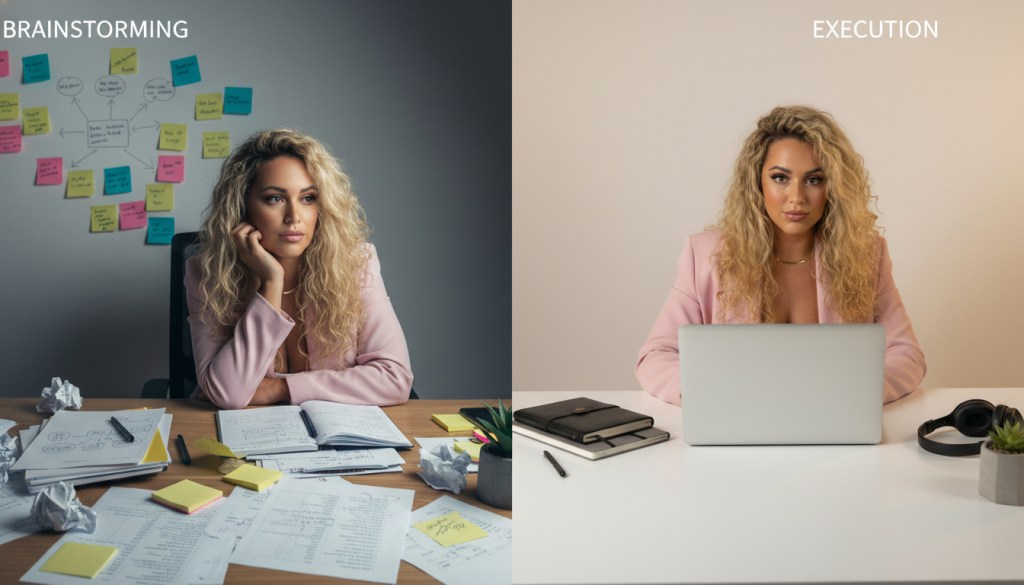
I used to spend hours thinking through every possibility before I made a move.
What if I changed this traffic approach? What if I repositioned the products this way? What if I built the structure differently?
I’d map it all out. Think through the scenarios. Try to plan for every outcome.
And then I’d sit on it. Because what if it didn’t work? What if I wasted money? What if there was something I was missing?
I was stuck in planning mode. Telling myself I was being strategic.
But after that Scale Up program last summer, something clicked.
I stopped planning everything to death. And started testing.
What All That “Planning” Really Was
Let me be honest about what I was actually doing:
I was scared to be wrong. So I kept thinking instead of doing.
I’d tell myself I was being careful. Thorough. Making sure I had all the information before I committed.
But really, I was avoiding taking the step to put something out there. I hesitated to see if it worked.
Because as long as it stayed in my head, it was still perfect. The second I executed; I’d get real feedback. And that feedback be this isn’t working.
So I stayed in idea mode. Where everything felt safer.
And meanwhile, nothing was moving. I was busy, but I wasn’t building anything.
The Shift That Changed How I Work
During Scale Up, I was in a room with other founders who were actually scaling.
And I noticed something: they weren’t planning for months before testing something. They were testing constantly.
One founder said something that stuck with me: “I don’t spend weeks planning anymore. I just build the simplest version, put it out, and adjust based on what actually happens.”
And I realized—I’d been doing it backwards.
I was trying to perfect something before I even knew if it would work.
Spending weeks thinking through scenarios that not even matter once I got real data.
That’s when I understood: having a strategy isn’t about having the perfect plan. It’s about knowing what to test next and actually testing it.
What Execution Looks Like Now
Execution isn’t reckless. It’s just faster.
Before: I’d spend weeks researching the best way to drive traffic before trying anything. Now: I pick one approach, run it for two weeks, look at what happened, then adjust or try something else.
Before: I’d try to design the perfect automation system on paper before building it. Now: I build the simplest version that solves the immediate problem. Then I improve it as I learn what’s actually slowing me down.
Before: I’d analyze every angle before deciding how to position a product. Now: I test a few approaches, see what people actually respond to, and go with that.
The difference is speed to feedback.
When you’re planning, you’re guessing. When you’re executing, you’re learning from real results.
What This Actually Looked Like in My Business
When I stepped away from the studio work last year and went all-in on e-commerce, I had a choice.
I spend months planning the perfect approach. Mapping out every system. Researching every traffic channel. Building the ideal workflow.
Or I just start.
I chose to start.
Traffic: I didn’t research every possible channel. I picked the one that made sense for my audience and ran a test. If it worked after two weeks, I’d scale it. If it didn’t, I’d move on.
Automation: I didn’t map out the perfect order processing workflow. I built the simplest automation that handled the most time-consuming step. Then I added to it when I found the next bottleneck.
Product positioning: I didn’t overthink the messaging. I tried three different ways of talking about my products in my content. The one that got responses became my positioning. The others got dropped.
None of it was perfect. But all of it moved the business ahead.
And that’s what matters.
The Question That Changed
The biggest shift isn’t what I do. It’s what I ask myself before I do it.
Before: “What if this doesn’t work?” Now: “How quickly can I find out if this works?”
Before: “What if I’m missing something important?” Now: “What’s the smallest test I can run to see if this is worth pursuing?”
Before: “I need to think this through more.” Now: “I need real data, and the only way to get it is to try.”
I still think strategically. But strategy without execution is just expensive overthinking.
The Hard Part About This
Execution requires something planning doesn’t: being okay with being wrong.
When you’re in planning mode, everything stays perfect. Because it’s all hypothetical.
The second you execute, you get real feedback. And sometimes that feedback is brutal.
I tested a traffic approach last month that I was sure would move the needle. It didn’t. The conversion rate was terrible and I wasted time on it.
Old me would’ve seen that as proof I should’ve planned more.
New me sees it differently. I got a clear answer in two weeks. I avoided spending two months planning something that still wouldn’t have worked.
That’s the trade-off. You move faster, but you’re wrong more often.
And you have to be okay with that.
The Mindset Shift That Changed Everything
Here’s what shifted for me:
I stopped seeing failed tests as wasted effort.
I started seeing them as information.
When something doesn’t work, I’m not starting over. I’m eliminating a path that doesn’t go where I need to go.
That’s just as valuable as finding the path that does work.
Every test—whether it succeeds or fails—gets me closer to what actually scales.
But only if I’m actually testing. Not just thinking about testing.
Where I Am Now
I don’t sit with ideas for weeks anymore.
I don’t wait until I feel completely ready or until I’ve thought through every scenario.
I test. I build. I adjust. I move.
Some things work. Some things don’t. But I’m learning from real data instead of theoretical planning.
And my business is growing because of it.
Not because I have perfect strategy. But because I’m executing fast enough to figure out what works.
That’s the shift.
From brainstorming what work to testing what actually does.
And as a single mother with no safety net, I can’t afford to stay in planning mode forever.
I need to move. Learn. Adjust. Build.
And that’s exactly what I’m doing.
— Michele Alexandria
Have you made this shift—from planning everything to just testing and adjusting? What finally pushed you to start executing?
Subscribe to my newsletter for more insights on moving from ideas to implementation. Real strategies from someone building and learning in real time.
 Michele Alexandria
Leave a comment