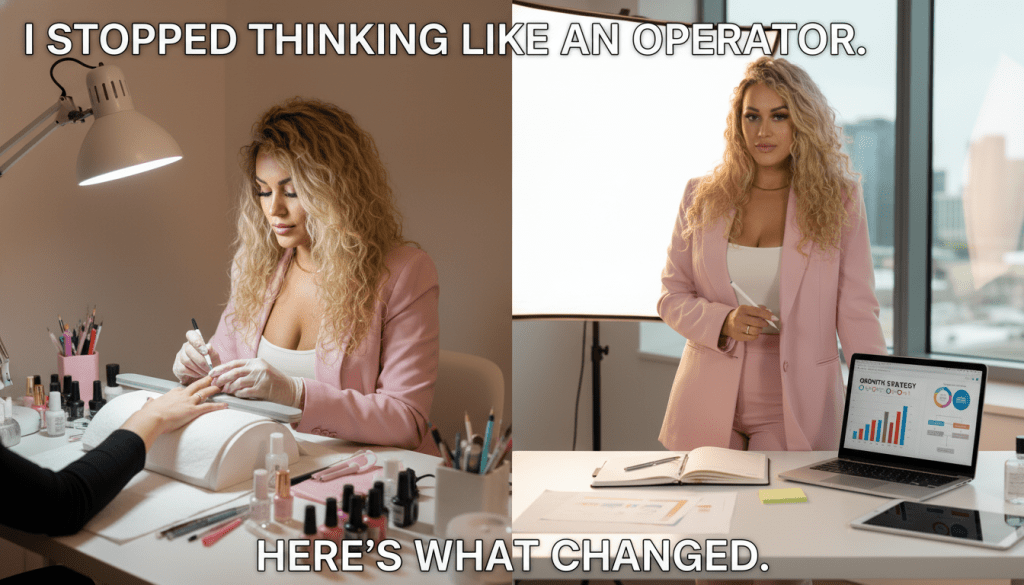
Last summer, I finished a 12-week program called Scale Up.
And somewhere in those 12 weeks, something shifted in how I thought about my business.
I stopped thinking like the person who has to do everything.
And started thinking like the person who builds the systems that do it.
I didn’t expect it. But once I saw it, I couldn’t go back.
What My Days Used to Look Like
For years, my default was: “I have to do this.”
Client booking comes in? I have to confirm it. Order placed? I have to process it. Inventory’s low? I have to reorder. Customer has a question? I have to answer. Something breaks? I have to fix it.
Every single thing that needed to happen in my business went through me first.
I was in the studio all day servicing clients. Then I’d come home and get my daughter to bed. Afterward, I’d switch over to the e-commerce side. This included processing orders, managing inventory, and answering emails. I was also building whatever system I was learning that week.
I learned my businesses by being in every part of them. By doing the work myself until I understood how it all fit together.
And for a long time, that’s exactly what I needed to do.
You can’t build systems for work you don’t understand. You can’t hand off what you haven’t done yourself.
But at some point, what got me here started keeping me stuck.
Because when you’re the center of everything, the business can’t grow past what you can personally handle.
And I was already maxed out.
The Exercise That Changed How I See My Business
During that program last summer, we mapped out our entire businesses.
Every process. Every task. Every decision point. Every place where you’re personally involved.
Then we had to ask: Where am I the bottleneck?
When I looked at my map, the answer was brutal.
I was the bottleneck everywhere.
Not because those tasks required my specific skill or judgment. But because I’d always been the one doing them, so I kept doing them.
And that’s when something clicked.
The question isn’t “What do I need to do today?”
The question is “What needs to get done, and does it actually need me?”
That shift—from me needing to do it to it just needing to get done—changed everything.
What Changed in How I Work
I’m not doing less. I’m doing different.
Before: I’d manually process every order as it came in. Now: I built automation that processes orders without me touching them.
Before: I’d answer the same customer questions over and over. Now: I created an FAQ system and email templates so 80% of questions get answered without me.
Before: I made every single decision. This included even the small ones. I was the only one who knew how things worked. Now: I’m documenting decision frameworks so the business can keep moving when I’m not available.
Before: I spent my days executing—doing the tasks that kept things running. Now: I’m focused on strategy—what drives traffic, what converts, what actually scales.
The work isn’t easier. It’s just leveraged.
And that’s the difference between being an operator and being a CEO.
The Bigger Shift: Stepping Away From the Studio
The biggest change came after that program ended.
I realized I didn’t just need to think differently. I needed to work differently.
So I made a decision I’d been avoiding: I stepped away from the studio work entirely.
The work that required me to physically show up. The appointments. The in-person services. The thing I’d built my business on for years.
It was steady income. It was what people knew me for. And walking away from it was terrifying.
But I couldn’t scale a business that required my body to be in the room.
So, I pivoted. Fully into the e-commerce side. The part that grows without me being tied to a location or a schedule.
The part where I build systems was exciting. I implement AI tools I’d been learning. It allowed me to create something that didn’t need me in every deal.
That’s the shift. Not just thinking like a CEO. But actually building like one.
The Identity Piece I’m Still Working Through
Here’s what nobody tells you about this transition:
It messes with your sense of self.
I built my entire identity around being the operator who does it all.
The woman who learned by doing. Who serviced clients herself. Who managed inventory late at night after her daughter went to bed. Who figured out systems because there was no one else to build them.
That version of me got me here. And I’m proud of her.
But she’s also the version who hit a ceiling. Who couldn’t grow because she was doing everything. Who was exhausted and maxed out with no path ahead.
So I’m learning to become someone else. Someone who builds instead of just executes. Someone who focuses on leverage instead of just effort.
And some days, I don’t recognize myself.
I’m in rooms with founders who are years ahead of me. I’m implementing strategies I never would’ve tried before. I’m making decisions as the CEO of a scaling business instead of the operator keeping things afloat.
I’m not the underdog fighting to survive anymore.
And I’m still figuring out who I am now that I’m not her.
What This Actually Looks Like Right Now
That shift happened last summer. But I’m still living in it every single day.
Some days I get it right. I focus on building. I trust the systems I’ve created. I protect my time for strategic work.
Other days I slip back. I try to control everything. I make myself the bottleneck again because it feels safer than letting go.
But the direction is clear.
I’m not going back to being the operator who has to do everything.
I’m building a business that can run without me being in the middle of it.
Not because I want to step away. But because that’s the only way it scales.
And as a single mother building this with no safety net, scaling isn’t optional. It’s the whole point.
The One Thing That Changed Everything
You don’t scale by working harder. You scale by thinking differently.
Not “What do I have to do?”
But “What needs to get done, and how do I build it so it doesn’t need me?”
That’s the shift.
From operator to CEO. From doing to building. From surviving to scaling.
And I’m still in the middle of learning what that means.
— Michele Alexandria
Have you made this shift—from being in everything to building systems that run without you? What changed for you?
Subscribe to my newsletter for honest insights on scaling, strategic pivots, and the identity work that comes with growth. Real talk from someone building in real time.
 Michele Alexandria
Leave a comment