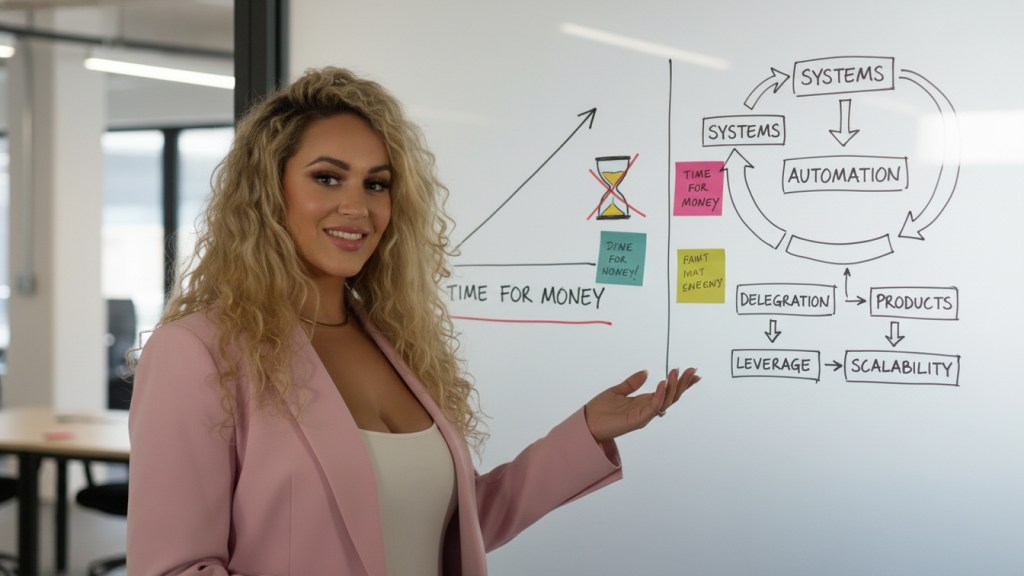
I used to think scaling meant working more hours. It actually meant working completely differently.
For years, I ran a nail studio. I was good at what I did, my clients loved me, and I was booked solid. But here’s the thing nobody tells you about being booked solid: your income has a ceiling. That ceiling is the number of hours you can physically work in a day.
I remember the exact moment I realized something had to change. I was sitting in my studio between appointments. I was calculating how many clients I’d need to see that week. I needed to cover bills, childcare, everything. The math was brutal. Even if I worked every available hour, there was only so much I can earn. And as a single mother, “every available hour” was already stretching me thin.
I looked at my schedule, completely full for the next three weeks, and felt exhausted instead of successful. That’s when it hit me: I had built a job, not a business.
The Pivot Nobody Warns You About
The decision to pivot from providing nail services to running an e-commerce nail supply business wasn’t some strategic masterstroke. It was necessity mixed with a bit of desperation and a lot of observation. I’d been ordering supplies for years. I knew what worked, what didn’t, what my clients actually needed versus what they thought they needed. That knowledge had value beyond the four walls of my studio.
But knowing I needed to change and actually changing were two completely different things.
The transition wasn’t clean. There was no moment where I closed the studio on Friday and opened an online store on Monday. It was messy. I was running appointments while building inventory systems on my laptop between clients. I was learning e-commerce platforms at midnight after my daughter went to bed. I was making mistakes, lots of them, and learning by doing because I couldn’t afford a course or a consultant.
Here’s what nobody tells you about moving from trading time for money to building systems. It requires an entirely different skill set. You need to develop and improve new abilities. You have to learn it while still paying your bills with the old model.
What Actually Changed (And I Mean Actually)
Inventory replaced appointments. Instead of managing a calendar of client bookings, I started managing stock levels, reorder points, and supplier relationships. The shift sounds simple, but it required learning to think differently. With appointments, you know exactly what’s coming in. With inventory, you’re predicting demand. You’re managing cash flow differently. You deal with products that sit or will sell out overnight. I built my first inventory tracking system in a Google Sheet. It was basic, but it worked. I’ve since upgraded, but that first system taught me more than any tutorial ever.
Systems replaced improvisation. In the studio, I improvise. A client showed up with damaged nails I wasn’t expecting? I’d figure it out in the moment. But e-commerce doesn’t allow for improvisation at scale. Every order needs to follow the same process. Every customer inquiry needs a systematic response. Every product needs consistent descriptions and categorization. I spent months building systems for order fulfillment, customer communication, and inventory management. Some of those systems I built wrong the first time and had to completely rebuild. That’s not failure, that’s how you learn what actually works versus what sounds good in theory.
Automation replaced manual tasks. The first thing I automated was order confirmation emails. Sounds small, but it freed up hours every week. Then came automated reorder alerts when inventory hit certain levels. Then customer follow-up sequences. Each automation gave me back time I could reinvest in building the next system. I’m still automating things, by the way. It’s not a one-time project, it’s an ongoing evolution.
Knowledge became the product. This is the part that took the longest to understand. In the studio, my skill served one client at a time. Now, that same knowledge about nail health, product quality, and proper technique helps hundreds of customers. It aids in product choice, descriptions, and the content I create. The knowledge I built over years of hands-on work didn’t disappear when I pivoted, it just scaled differently.
The Part Nobody Posts About
Let me be honest about what this transition actually looked like. If you’re considering a similar pivot, you need to know the real story. It’s important to understand the full picture, not just the highlight reel.
It wasn’t an overnight switch. I ran both models for longer than I’d like to admit. Some weeks I made more from the studio, some weeks e-commerce pulled ahead. The stability came gradually, not suddenly.
I learned by doing, not by copying some step-by-step blueprint. I’d love to tell you I bought a course and followed it perfectly, but that’s not what happened. I figured out what I needed to learn when I ran into problems. Then I found resources to solve those specific problems. This approach was messy. Nevertheless, it also meant I learned deeply because I was solving my actual issues. They were not theoretical ones.
Some systems I built wrong the first time. My first inventory tracking system didn’t account for products with variations in size or color. My first customer communication system sent way too many emails. My original website navigation made sense to me but confused everyone else. I had to rebuild things. Multiple times. That’s normal, even though nobody talks about it.
The emotional adjustment of letting go of direct client contact was harder than I expected. I loved my clients. I knew their names, their stories, what was happening in their lives. Moving to e-commerce meant serving more people but knowing them less personally. I had to find new ways to create connection, and I had to accept that the relationship dynamic was different. Not worse, just different.
What This Actually Means For You
You are still trading time for money. You feel that ceiling I felt. You already know something needs to change. The question isn’t whether to build systems, it’s which system to build first.
Here’s what I learned: start with the setup that will save you the most time. Alternatively, tackle the setup that solves your biggest pain point. For me, that was inventory management because I was spending hours manually tracking stock. For you, it be scheduling, or client communication, or financial tracking, or content creation.
Pick one. Build it imperfectly. Use it. Refine it. Then move to the next one.
You don’t need to have it all figured out before you start. I certainly didn’t. You learn what you need to know when you need to know it. That’s not a weakness in your approach, that’s exactly how this works.
The business I run now looks completely different from the one I ran five years ago. I work different hours, serve different people, use different skills. The foundation is the knowledge about nail health and what actually works. It came from all those hours in the studio working one-on-one with clients. Those years weren’t wasted, they were the education that makes everything I do now possible.
Your current model isn’t a dead end. It’s the training ground for whatever comes next.
So here’s my question for you: If you’re still trading time for money, consider what system you could build this quarter. Could it give you back even five hours a week? Start there. Build that. The next system will reveal itself once you’ve got the first one working.
You don’t need to have the whole path mapped out. You just need to take the first step toward working differently instead of just working more.
Michele Alexandria
P.S. – If you build that first system, I’d love to hear what you chose and how it’s going. Reply to this email or DM me. I’m genuinely curious what systems matter most to people in different types of businesses.
 Michele Alexandria
Leave a comment